Blueground left Portugal.
Tenants are still
waiting to be paid.
On March 17, 2026, Blueground, the global provider of furnished short and medium term rentals, announced that its operations in Portugal were ending. Tenants were told to be out by May 30, 2026, regardless of the leases they had signed. Deposits that were due back within 30 days still have not been returned. This site exists to hold Blueground accountable to its customers.
What happened
March 17, 2026
Blueground announces it is leaving Portugal
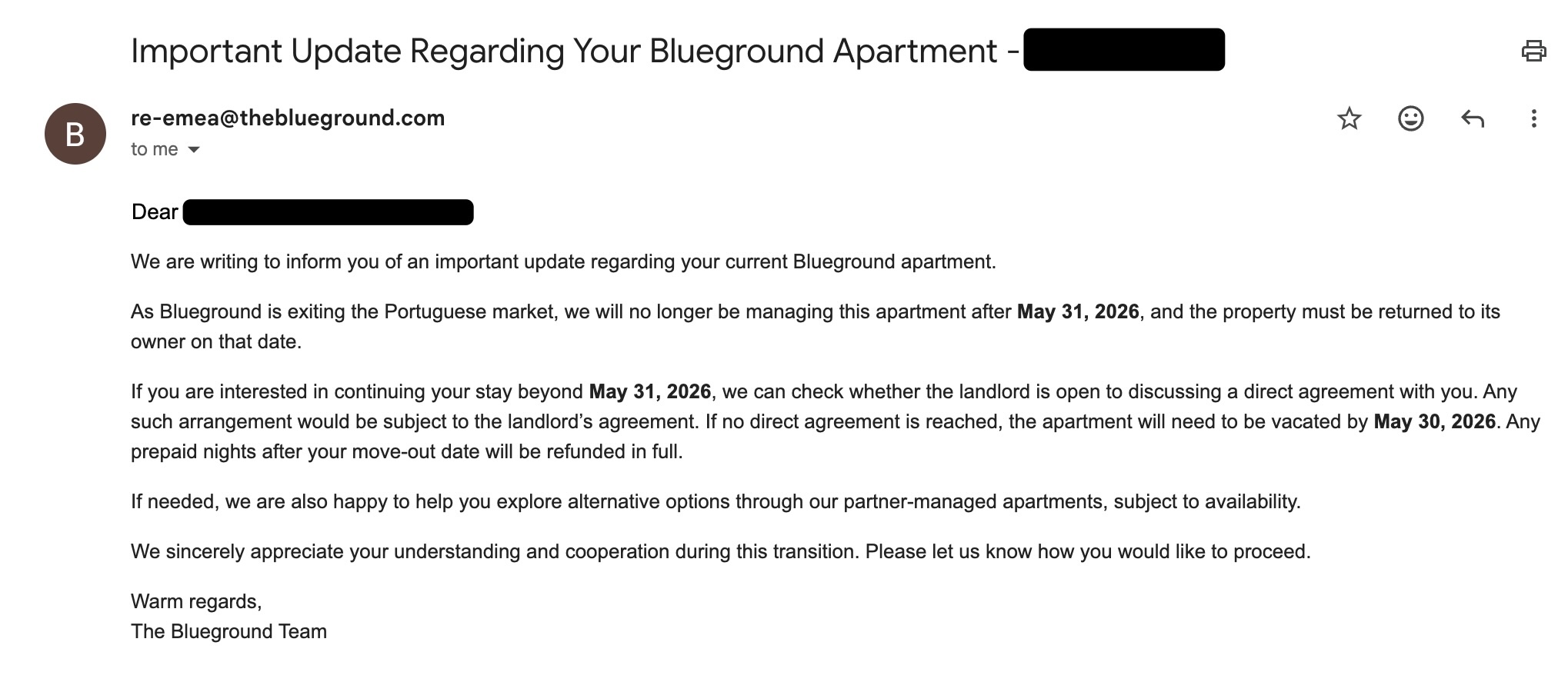
Tenants were told Blueground was winding down its Portuguese operation and that their leases were ending regardless of the terms they had signed. Blueground wrote that it would “no longer be managing this apartment after May 31, 2026” and that, without a direct agreement with the landlord, apartments had to be vacated by May 30, 2026.[1][9]
April – May 2026
Tenants absorb the cost
Each tenant had to negotiate a direct lease with their landlord or find a new home in a tight Lisbon market, at their own expense in time and money. Blueground offered only to ask whether landlords were open to direct agreements, and pointed tenants to partner-managed apartments “subject to availability”.[9][1]
June 30, 2026
The Lisbon office closes
Blueground’s Lisbon office closed and its staff, including its local director, were let go. The local phone lines were disconnected and in-app support was switched off for Blueground Portugal customers, leaving no one in Portugal to contact.
July 8, 2026
Deposits still unpaid
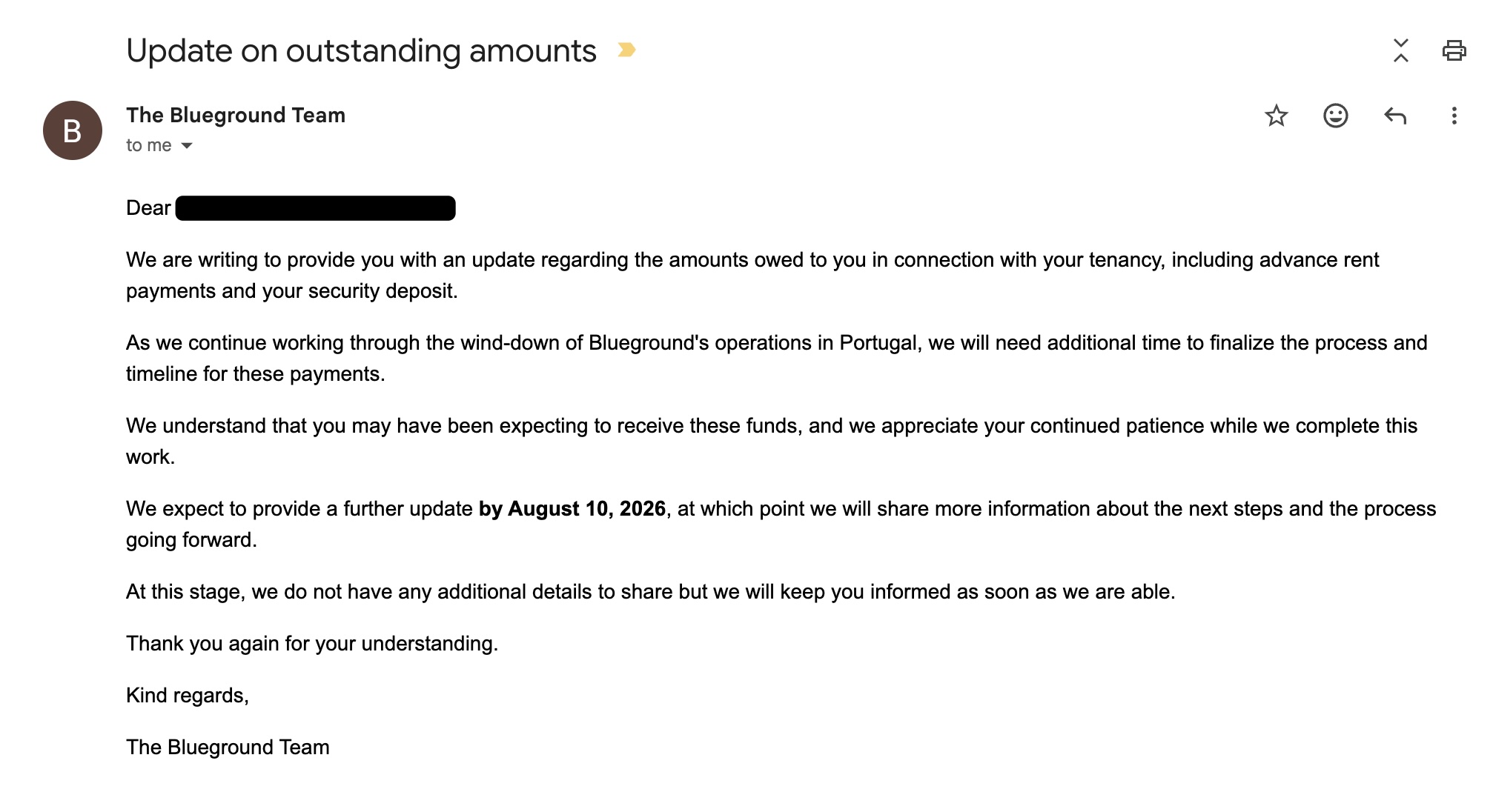
Under the standard contract, deposits were due back within 30 days of moving out. For many tenants that deadline passed with no refund and no deductions notified.[7][2][3]Blueground’s email acknowledges the amounts owed, deposits and advance rent included, but promises only “a further update by August 10, 2026”, with no payment date.[8]
Why Blueground is in breach
The termination was a breach of contract
Each lease was a fixed-term contract, and Blueground had no right to end it early. Under Clause 2.2, the contract only ends early if the landlord’s own lease over the apartment ends, and tenants were never shown proof of that. It was Blueground itself that set those terminations in motion by deciding to leave Portugal. Under Article 1089 of the Civil Code, that keeps Blueground liable to tenants in damages even though the lease lapses.
Tenants bore the costs
Higher rent at a new home, moving costs, furnishing costs, agency fees. Clause 2.3 required Blueground either to offer an equivalent apartment or to refund in full the amounts paid for the remaining term, and it did neither. Clause 16 makes the party in breach liable to compensate the other side for all resulting losses. None of it has been offered.
Clauses 2.3 and 16 [7]
The deposits have not been returned
Deposits were due back within 30 days of moving out, absent documented deductions, and none were notified. Blueground’s July 8 email acknowledges the money is owed, deposits and advance rent included, but gives no payment date.
The emails Blueground sent
What you can do right now
1. Formally claim your deposit and damages
Generate a formal demand letter (interpelação) in two minutes. Claim your unreturned security deposit, prepaid rent, and the other costs of the termination, such as the rent difference at your new home, moving costs and furnishing costs. The letter creates a formal record of default and starts the clock on interest and deadlines.
Use the letter tool2. File legal action
For claims up to €15,000, the Julgados de Paz are a fast, low-cost route to a judgment, no lawyer needed. For claims up to €5,000, consumer arbitration at the Centro de Arbitragem de Lisboa is also available, and the company cannot refuse it.
3. Speak out
File a complaint with DECO and in the Livro de Reclamações Eletrónico, and share your experience on Trustpilot, r/blueground and r/PortugalExpats. Stick to facts you can document.
Contact Blueground
Blueground’s Lisbon office closed on June 30, 2026, and its Portuguese phone line is no longer in service. In-app support is no longer available to Blueground Portugal customers. The channels below remain active.
Support line
+30 210 89 83 651When you write to Blueground, send your message to all three addresses.
Executive team



Blueground & Portugal: what people are asking
+Is Blueground leaving Portugal?
Yes. On March 17, 2026, Blueground announced it was winding down its Portuguese operation. Tenants were told their leases were ending regardless of the terms they had signed, and that apartments had to be vacated by May 30, 2026 unless they reached a direct agreement with the landlord.
+Was Blueground allowed to terminate my lease early?
In our position, which is shared by lawyers consulted by affected tenants, no. The standard contract gives Blueground no early-termination right: Clause 2.2 only applies when the landlord's own lease over the apartment ends, and tenants were never shown proof of that. Blueground itself initiated those terminations. Article 1089 of the Civil Code keeps Blueground liable to tenants in damages, and Clause 2.3 required it to offer relocation or a full refund for the remaining term. It did neither.
+When will Blueground refund my security deposit?
The standard contract requires deposits back within 30 days of moving out, absent documented deductions (Clause 3.4). That deadline has passed for many tenants, with no deductions notified. On July 8, 2026, Blueground emailed tenants acknowledging 'the amounts owed to you in connection with your tenancy, including advance rent payments and your security deposit', promising only 'a further update by August 10, 2026'. Keep every email as evidence, and put your claim in writing. Generate your demand letter →
+What compensation can affected tenants claim?
Three buckets: the extra rent you now pay, moving costs, and other documented losses, on top of the deposit itself. Clause 16 of the contract makes the party in breach liable for all resulting losses. Interest at the legal rate also runs automatically on money debts from the day their deadline passes. Generate your demand letter →
+Did Blueground do this in other countries too?
Portugal is not an isolated case. Blueground shut down its Spanish operation in a similar manner, and former tenants there also described problems recovering their deposits.
+Is a lawsuit or collective action being organized?
Affected tenants are organizing to pursue their claims together, through a tenants' association and, if necessary, joint legal action in Portugal. When you generate a demand letter with the letter tool, you can opt in to be kept informed: only your name, email and phone number are stored, with your consent, and nothing else.
+What are my rights under Portuguese law?
Two protections matter most here. Article 1089 of the Civil Code keeps the sublessor liable to the subtenant when the head lease ends for a cause attributable to the sublessor, and Article 9 of the NRAU requires lease-cessation notices in writing, sent by registered letter. To enforce them you can complain to DECO or in the Livro de Reclamações, file with the Julgados de Paz (up to €15,000) or consumer arbitration (up to €5,000), or go to the Lisbon Judicial Court.
Sources
- [1]“Blueground is exiting Portugal”, a March 2026 discussion among affected tenants on r/PortugalExpats. View source
- [2]“Anyone had problems getting a deposit back from Blueground in Portugal?”, a July 2026 thread on r/PortugalExpats: deposits and cleaning fees unpaid more than 40 days after moving out, with no deductions claimed. View source
- [3]Portal da Queixa complaint, July 3, 2026: retention of a €2,476 deposit after a Lisbon lease that ended May 31, 2026. View source
- [4]Trustpilot reviews mentioning Lisbon and Portugal. In a public reply, Blueground acknowledges “the concern around outstanding payments during this transition”. View source
- [5]Article 1089 of the Portuguese Civil Code (Caducidade): the sublease lapses when the head lease ends, “sem prejuízo da responsabilidade do sublocador para com o sublocatário, quando o motivo da extinção lhe seja imputável” (without prejudice to the sublessor's liability to the subtenant when the cause of the termination is attributable to the sublessor). View source
- [6]Article 9(1) of the NRAU (Law 6/2006): legally required lease-cessation communications must be in writing, signed, and sent by registered letter with acknowledgment of receipt. View source
- [7]Blueground's standard Lisbon sublease agreement (BGPROP Portugal, Unipessoal Lda): Clauses 2.2–2.3 and 2.7 (termination and extensions), 3.4 (deposit within 30 days), 12 (warranties), 16 (indemnify all losses) and 17 (notices). Copies held by the organizers of this action.
- [8]Email from Blueground to affected tenants, July 8, 2026 (“Update on outstanding amounts”), acknowledging “the amounts owed to you in connection with your tenancy, including advance rent payments and your security deposit” and promising only “a further update by August 10, 2026”. Screenshot above. View screenshot
- [9]Termination email from Blueground: “As Blueground is exiting the Portuguese market, we will no longer be managing this apartment after May 31, 2026 … If no direct agreement is reached, the apartment will need to be vacated by May 30, 2026.” Screenshot above. View screenshot
- [10]Articles 804 to 806 of the Portuguese Civil Code: money debts with a fixed deadline are automatically in default when the deadline passes and carry interest at the legal rate. View source
- [11]Trustpilot reviews mentioning Spain: former tenants describe deposit problems during the shutdown of Blueground's Spanish operation. View source
Legal references
- Código Civil, Artigo 1089.º — Caducidade of the sublease; the sublessor remains liable to the subtenant where the cause of the head lease's extinction is attributable to the sublessor. Diário da República
- Código Civil, Artigos 562.º–564.º — Obligation to compensate; scope of damages, including actual losses and lost profits. Diário da República
- Código Civil, Artigo 798.º — Debtor's liability for losses caused by culpable non-performance of an obligation. Diário da República
- Código Civil, Artigos 804.º–806.º — Debtor's default; money debts with a fixed deadline are in default automatically and carry interest at the legal rate. Diário da República
- Lei n.º 6/2006 (NRAU), Artigo 9.º — Form of legally required communications concerning the cessation of a lease. Diário da República
- Decreto-Lei n.º 446/85 — Regime of unfair standard contract terms; abusive standard terms can be declared void. Diário da República
- Lei n.º 24/96 — Consumer Protection Law (Lei de Defesa do Consumidor). Diário da República
- Decreto-Lei n.º 24/2014 — Regime of distance and off-premises contracts. Diário da República
- Portaria n.º 291/2003 — Sets the civil legal interest rate at 4% per year (with Article 559 of the Civil Code; last verified July 2026). Diário da República
- Código Civil, Artigo 342.º(2) — Burden of proof: the party invoking an extinctive fact, such as caducidade, must prove it. Diário da República
- Código Civil, Artigos 559.º and 310.º(d) — Legal interest rate by portaria; interest claims prescribe in five years. Diário da República
- Código das Sociedades Comerciais, Artigo 163.º — After a company's liquidation closes, creditors may claim against former shareholders up to the assets distributed to them. Diário da República